How It Works
From who you are to what you do today
Business Math combines a fixed, guided sequence of decisions with personal recommendations. Every phase reuses what you already approved, so the plan stays yours from the first question to today’s checklist.
One record, one pathway, one loop
Everything you approve is saved to one shared record. Each phase reads from it and writes back to it, so you are never asked the same thing twice and a change in one place updates what depends on it.
- LearnYour answers and evidence
- RecommendRanked options with reasons
- DecideYou approve, edit or reject
- ActSpecific tasks, inside or outside the app
- Check inResults and evidence come back
- UpdateAffected decisions recalculate
The same path for every business
A landscaper, an online store, a software company and a nonprofit work through the same decisions in the same order. Wording, units, examples and evidence adapt to the business. No one is sent down a separate track.
Phases finish when the work is real
A phase is complete only when its output is approved. Viewing an explanation, uploading an unreviewed file or clicking a link never completes a task. A contradiction routes you back to the exact earlier decision that caused it.
How personalization works
Personalization changes how decisions are presented and prioritized. It does not lower the standard. A founder with limited time gets a smaller, sequenced set of tasks; one with more time may get more in parallel. Both see the same risks and evidence requirements.
Rankings you can inspect
Business options are scored with disclosed weights, not a hidden black box. In Opportunity Discovery, for example, founder skills and experience count for 12%, income and margin potential 11%, demand and Business Vision fit 10% each, and your own priority ranking adjusts the weights. Impossible options are removed first. Each result is shown as one to five stars with a plain-language explanation, pros and cons, uncertainty and what would change the ranking.
Phase 1 · Founder Discovery
Understand you
Before any business is suggested, Business Math builds a Founder Thesis: a confirmed picture of your life, skills, money, time and goals.
What you contribute
- Your situation, responsibilities and protected times
- Strengths, weaknesses, skills and work history
- Expenses, savings, borrowing limits and funding preferences
- Preferences for work, customers, revenue and risk
What Business Math helps produce
- Your survival income floor, income targets and runway
- Safe startup capital
- Founder advantages and contradictions to resolve
- An approved, versioned Founder Thesis
Why it matters
Every later ranking and workload uses this record. A business that needs more hours or money than you have is ruled out before you see it.
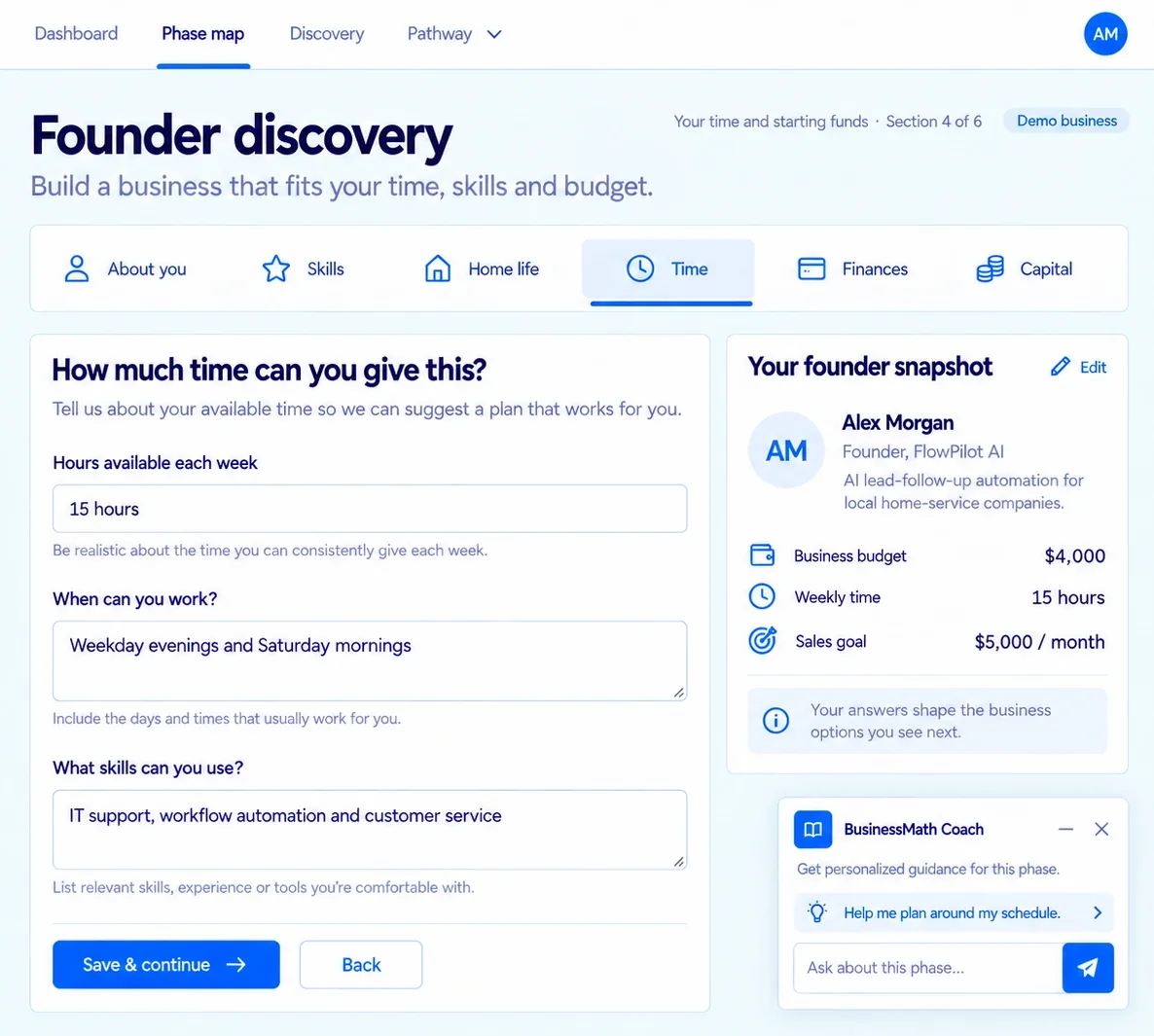
Fictional example Alex Morgan, FlowPilot AI
Alex can give 15 hours a week on weekday evenings and Saturday mornings, has $4,000 to start and a monthly sales goal of $5,000. Alex is keeping a job while launching and lists IT support, workflow automation and customer service as top skills.
Phase 2 · Opportunity Discovery
Compare business opportunities
After you approve a Business Vision, Business Math generates about 30–75 ideas, removes the impossible ones and ranks the rest for you.
What you contribute
- Why you want a business and what success means
- A ranking of your priorities, such as fast first revenue or low startup cost
- Any ideas of your own
What Business Math helps produce
- 10–20 ranked businesses with one-to-five-star fit ratings
- Research confidence shown separately from the rating
- Removed ideas, each with its reason
- A “why this fits you” explanation for each
Why it matters
You see tradeoffs side by side before committing, and you can ask why any business ranked where it did.
Fictional example Alex Morgan, FlowPilot AI
| Business | Fit | Confidence | Note |
|---|---|---|---|
| AI lead follow-up for home-service companies | ★★★★☆ | Moderate | Best overall fit |
| Workflow automation for accounting firms | ★★★★☆ | Low | Lowest startup cost |
| After-hours help desk | Removed | – | Needs more hours than Alex has |
Phase 2 · Opportunity Discovery
Choose a business and three starting services
You compare up to five finalists, work through tradeoff scenarios and select one business. Business Math then recommends three services that work together.
What you contribute
- Your finalists and reflection on which fits your real life
- Accept, replace or edit for each service
What Business Math helps produce
- One selected business, target customer and location
- An entry service, a stronger-profit service and a recurring service
- A list of assumptions still to validate
Why it matters
The three services are chosen to work together: one easier to sell, one that adds value and one that brings customers back.
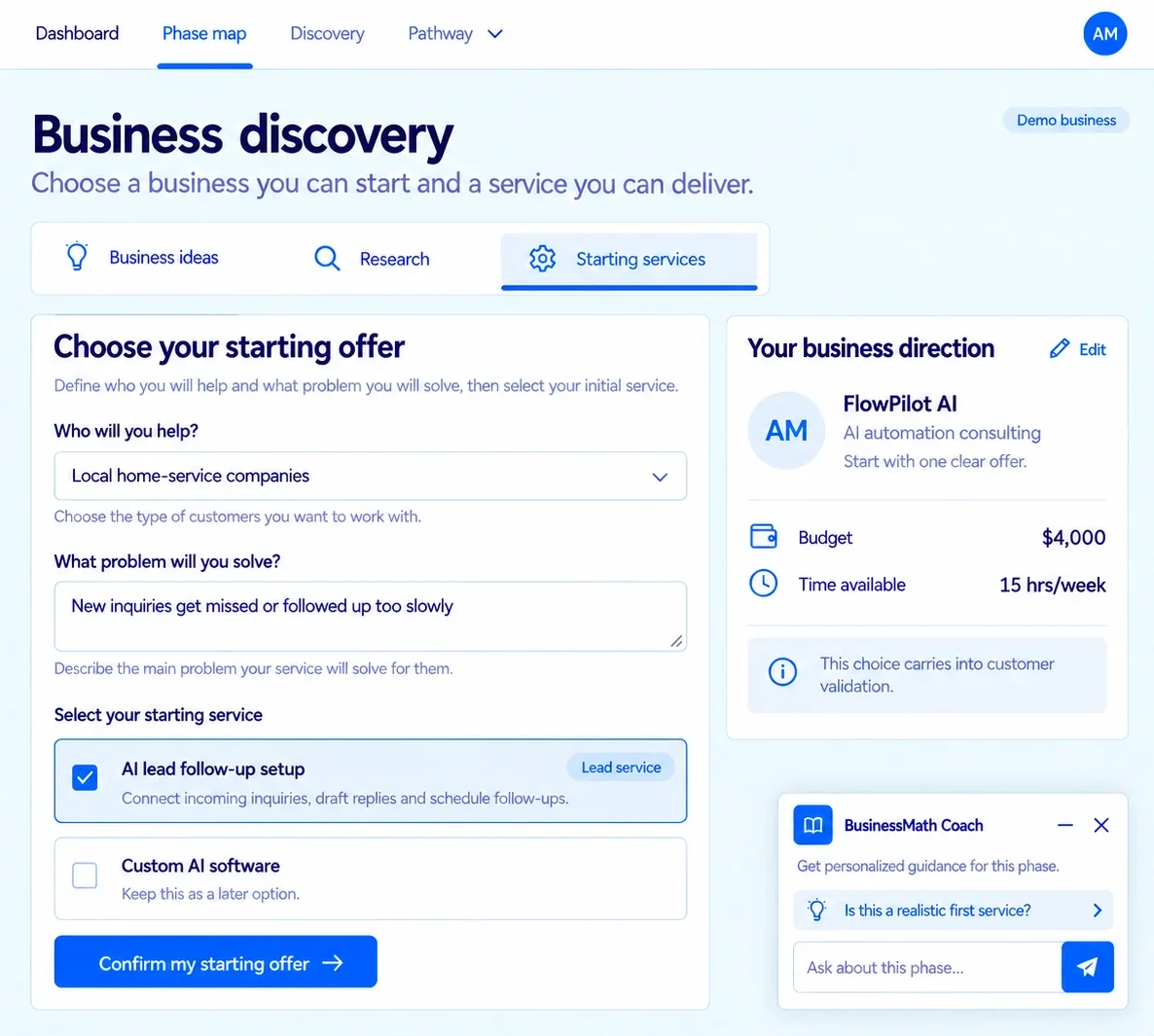
Fictional example Alex Morgan, FlowPilot AI
- Entry: Missed-lead review
- Stronger profit: AI lead follow-up setup
- Recurring: Monthly follow-up support
Phase 3 · Market and Customer Validation
Validate demand with real customers
You test the riskiest assumptions with the least expensive ethical method, such as conversations, observation, a quote request or a small paid pilot.
What you contribute
- Outside actions using prepared scripts
- Results with source, date and limits
What Business Math helps produce
- A claim-by-claim evidence ledger
- A Validation Brief
- A decision: pass, revise, retest or stop
Why it matters
Interest is not the same as payment. Testing before building protects your time and money.
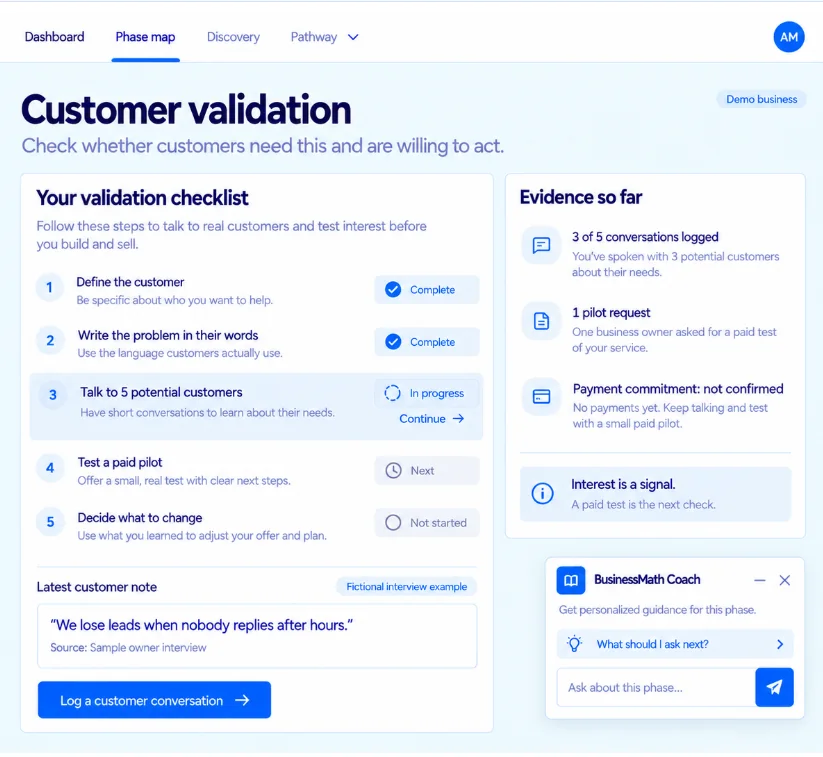
Fictional example Alex Morgan, FlowPilot AI
- 3 of 5 conversations logged
- 1 pilot request
- Payment commitment: not confirmed
“We lose leads when nobody replies after hours.”Fictional interview example
Phases 4–9
Build the business plan, one phase at a time
The offer, economics, brand, legal setup, financial systems and fulfillment readiness are each completed and approved in order.
What you contribute
- Decisions on scope, price, spending and identity
- Outside actions: quotes, filings, account setup, insurance
- A controlled rehearsal of delivery
What Business Math helps produce
- A Minimum Business Model and working offer sheet
- Provisional price cards, budgets and a cash-flow timeline
- A brand kit, legal readiness record and tested payment setup
- Launch Authorization for exactly what passed
Why it matters
No customer is charged until the legal, financial and fulfillment checks for that activity pass.
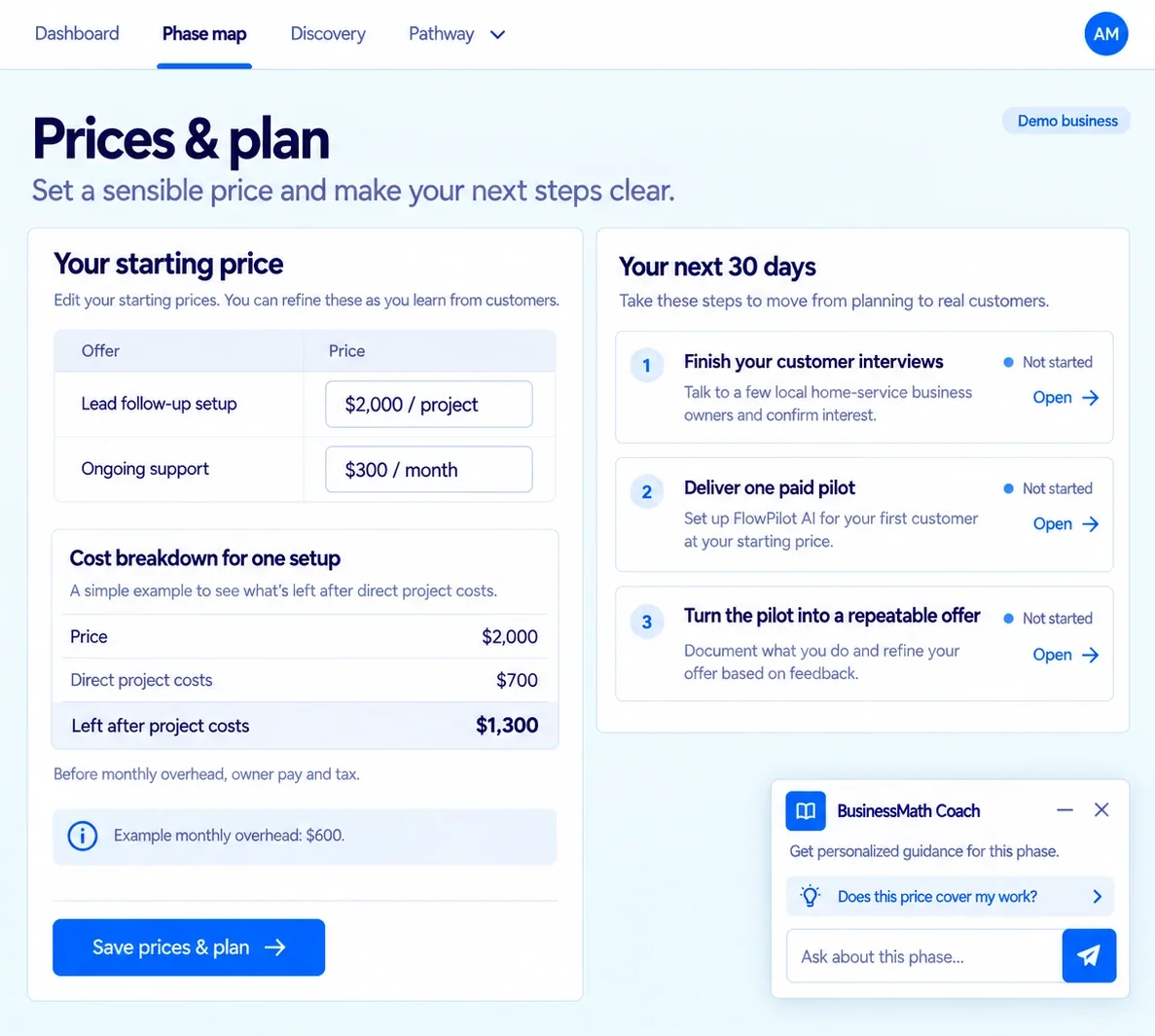
Fictional example Alex Morgan, FlowPilot AI
Before monthly overhead, owner pay and tax. About 10 hours per setup, so roughly one new setup a week.
Phases 10–14
Prove it, then build the systems
A controlled first sale tests the real business. Results correct the model, then the sales system, digital presence and measurable marketing are built on what actually happened.
What you contribute
- Messages you send yourself and their real results
- Actual time, cost and feedback
- Approval of channels, budgets and stop rules
What Business Math helps produce
- A Proof-of-Revenue Report
- A revised business model
- A CRM, website and connected lead sources
- Marketing experiments and a Business Operations Record
Why it matters
Systems and marketing are built on evidence, not guesses, and a well-run test with no sale still counts as useful learning.
Fictional example Alex Morgan, FlowPilot AI
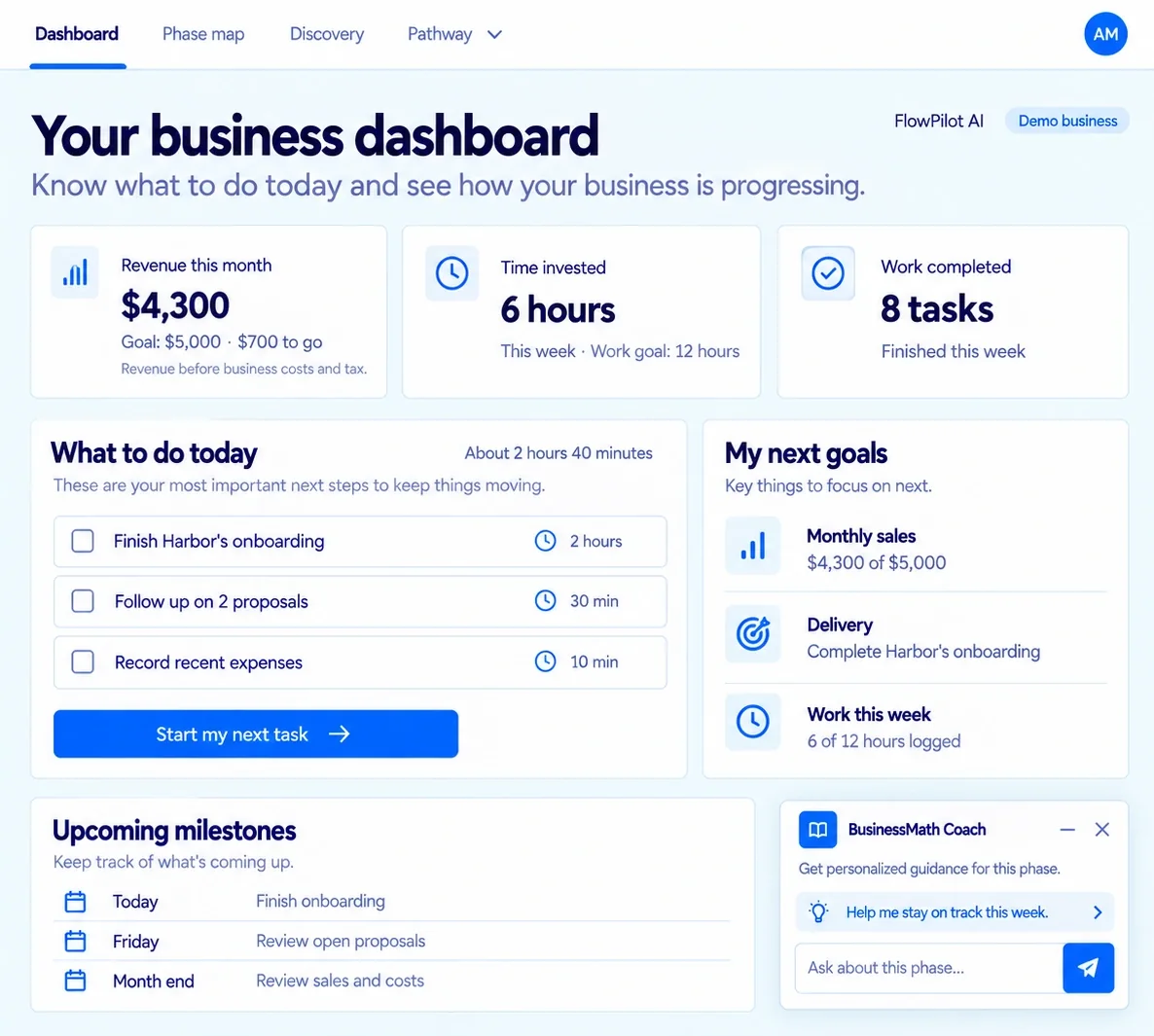
Later in the example, Alex has two paying customers.
- Finish Harbor’s onboarding2 hours
- Follow up on 2 proposals30 min
- Record recent expenses10 min
After the core pathway
Keep improving with Consultant Mode
Business Math becomes an ongoing advisor that watches approved results, asks focused questions and recommends the next most useful work.
What you contribute
- Updates as things change
- Accept, edit, defer or reject for each recommendation
What Business Math helps produce
- A daily pulse and weekly review
- A 14-day consultation with 3–7 tasks sized to your time
- Monthly, quarterly and annual reviews
Why it matters
Businesses change. Guidance that knows your history can tell you what deserves attention now, and does not invent work when nothing needs deciding.
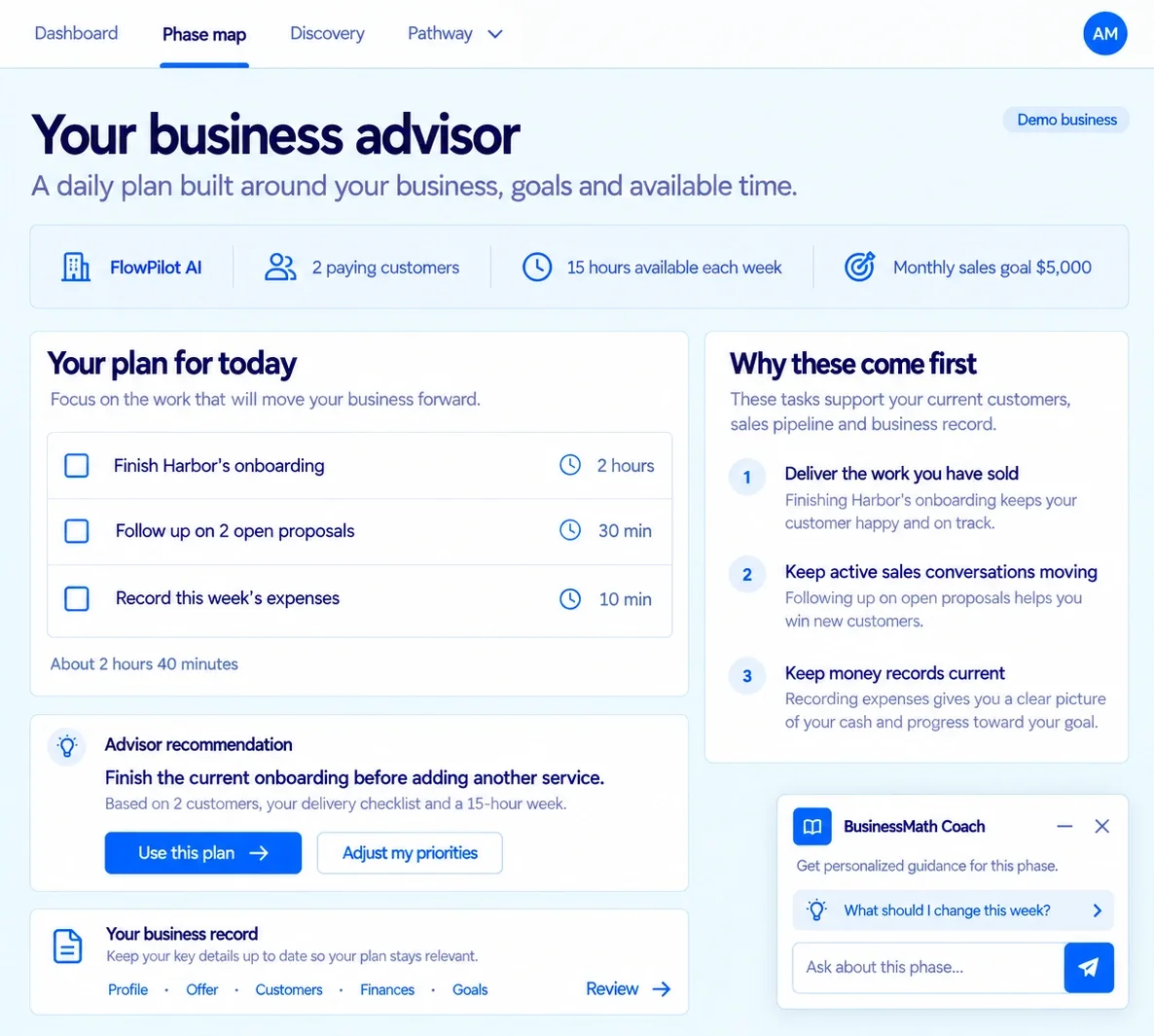
Fictional example Alex Morgan, FlowPilot AI
Finish the current onboarding before adding another service.Advisor recommendation, based on 2 customers, a delivery checklist and a 15-hour week
How a task works
Much of building a business happens outside an app: calls, quotes, filings, conversations. Business Math treats that work as real tasks. Each one gives you the outcome in one sentence, the exact person or place to contact, a copyable script or checklist and what counts as evidence. You also get “I can’t do this”, “I need help” and “I received no response” routes.
- 1PreparedWhy it matters, exact instructions, a script or checklist, where to go and what counts as done
- 2You reviewYou confirm you understand, or ask for help
- 3You act outside the appMake the call, send the message, request the quote
- 4WaitingA follow-up date is set; other work continues
- 5Check back inRecord what happened and upload evidence
- 6ConfirmBusiness Math extracts the details; you confirm them
- 7RecalculateAffected numbers and decisions update, and the next task unlocks
Every important number is labeled
Business Math keeps track of how much it actually knows. Each meaningful value carries a label, a source and a date, and an AI-written summary can never upgrade a label. An empty answer means unknown, not “no”.
- ApprovedYou confirmed it
- ObservedSeen in real activity, such as a payment or delivery
- EstimatedCalculated or researched, not yet confirmed
- AssumedBelieved but not tested
- StaleToo old to rely on without rechecking
- DisputedSources disagree; the conflict stays visible
- UnknownNot known yet, never treated as true or false
Ongoing guidance: Consultant Mode
Business Math continuously organizes what it knows about you and your business, watches approved results, asks focused questions when important facts may have changed, and recommends the next most useful actions with clear reasoning, instructions, limits and evidence requirements. You remain the decision-maker.
| When | What happens |
|---|---|
| As things happen | A new sale, expense, complaint, lead or changed fact updates only what it affects |
| Daily | A short pulse: one priority, warnings and anything waiting |
| Weekly | What moved, what stalled and what needs a decision |
| Every 14 days | A strategic consultation that produces an approved plan of 3–7 tasks sized to your time |
| Monthly | A business health report covering economics, funnel, operations and founder fit |
| Quarterly | A strategy reset: continue, change, pause or retire priorities |
| Annually | An updated thesis, strategy and operating baseline |
Four queues keep work manageable
- Do nowTime-sensitive protection, commitments and the few highest-value actions
- This cycleThe approved 14-day portfolio
- WaitingOutside requests with follow-up dates
- BacklogValuable work saved for later
If the business is stable, Consultant Mode shows maintenance and the next review instead of inventing work. Repeated deferral leads to a question about what’s in the way, not a judgment.
What to expect from the guidance
- You make the decisions. Recommendations are decision support. You can edit, reject, pause, export or delete your records.
- It is a guide, not a professional. It is not a law firm, accountant, bank or insurer. For regulated questions it prepares you for a qualified professional.
- No guaranteed results. It cannot guarantee compliance, coverage, profit or customer behavior. Reports state their scope, date and limits.
See the logic in action.
The Product Preview simulates how a founder’s time, money and priorities change the ranked businesses and the tasks that follow.